How Indian Ocean trade, coastal women's creativity and textile innovation gave rise to one of East Africa's most recognisable fabrics.
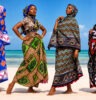
In Mombasa, Zanzibar and across the East African coast, the kanga is a familiar sight. Wrapped around the waist, draped over the shoulders or folded into a head covering, this colourful textile has become part of the region’s everyday fashion vocabulary.
Yet the kanga’s story begins long before its contemporary interpretations. Its history reveals a fascinating relationship between international trade, local creativity and the evolution of African dress.
A Textile Born from Cultural Exchange
The modern kanga emerged during the nineteenth century along the Swahili coast, where trading communities connected East Africa with Arabia, India and Europe.
A documented account describes coastal women sewing together imported printed handkerchiefs, known by the Portuguese term lenço, to create larger pieces of wearable cloth. Six handkerchiefs were commonly arranged in two rows of three.
These early arrangements gradually evolved into single rectangular textiles, initially produced through hand-printing and later manufactured industrially.
The history was not simply one of imported fashion. Women along the coast helped determine how the new textile would be worn, which designs became desirable and what cultural meanings developed around it.
Why Is It Called a Kanga?
The name is commonly associated with the Kiswahili word for the guinea fowl, a bird recognised by its spotted plumage.
Some early printed cloths featured small contrasting dots resembling those markings. As the textile evolved, these simple patterns gave way to increasingly elaborate floral, geometric and pictorial designs.
The kanga became distinctive not because of one permanent pattern, but because of a recognisable visual structure that could accommodate changing tastes.
From a Coastal Wrap to an East African Essential
The kanga gradually became widely used beyond its coastal origins.
Its appeal was practical as well as aesthetic. Lightweight and adaptable, it could be wrapped, folded, layered or used for household purposes.
It became particularly associated with women’s dress, although men and children have also used kangas in ceremonial settings.
Today, the textile remains strongly associated with Kenya and Tanzania, while its influence extends into other parts of East Africa and across the Indian Ocean.
Continue Exploring
In Part Two of our Kanga series, discover the distinctive structure of the cloth and how its designs became part of social communication.